
Author: Wideopenmind.net

  • Debunking Myths: The Relevance of Algebra Today

    Screenshot

    Every now and again I have hope for our country but then I go on social media where I read things that literally suck the life out of me. In a nation where are participants in a global information economy and have so much knowledge at our disposal how can we have so many citizens who actively work to devalue that same knowledge? It’s simply astounding to me. Today I want to discuss one of the dumbest social media arguments I have seen in the past 10 years about the need to teach algebra in schools. Social media posts on this topic usually look something like this.

    “Well, another day has passed and I did not use algebra”

    The implication is that algebra is useless and unnecessary in everyday life. The supporters of this movement argue that our schools have failed our children by focusing on esoteric subjects, like algebra, when they should focus on practical life skills. I am unsure on which specific practical skills they would rather focus. However, it is not about only about adding practical skills to the curriculum though because many of these people also want schools to stop teaching humanities, art and music. Why someone would not want their child learning algebra eludes me.

    Although I concede that trigonometry, calculus and some higher math skills are probably unnecessary for many, basic algebra and geometry are as about as practical as you can get in terms of useful knowledge. Algebra is used quite often in daily life whether you realize it or not and here are a few use cases but I could literally list hundreds:

    1. How many bags of much or fertilizer should I buy for my garden or lawn?
    2. How long will it take me to drive from my home to Ft. Lauderdale, FL for vactaion?
    3. How much will the fuel cost me to make the trip above?
    4. How many square feet of carpet do I need for this room?
    5. What is my net effective tax rate if I made $50,000 and paid $2,153 in taxes this year?
    6. How much will I pay in interest on my new car if the car is $30,000 and my interest rate is 6.9% for 4 years? Would it be better to take the 5 year loan for 4.9%? How does my payment change if I put down 10%
    7. What should a TV cost me if it costs $329 and there is a 25% discount?

    These are basic, practical questions that almost everyone faces in everyday life. Yes, we have apps and tools to help us with these things now so we can easily get the answers to many of these questions but, without some level of basic knowledge, one would have no idea how the answer was derived or if it is even correct. Using the above list, imagine the cashier rings up the TV and it registers at $279. Is it correct?

    I agree with the basic premise that we should teach more practical life skills in schools but why must it be a zero sum game? Why do we assume that teaching algebra in some way blocks us from teaching other things. Why can’t we teach algebra AND other practical skills such as financial management, basic home maintenance, etc.

    Most education up until just a few hundred years ago was class differentiated. Apprenticeship programs and on the job training was the norm for most people and only the elite were able to spend time delving into language, history, philosophy, art and music. These people were educated for leadership. Military officers studied military history, politics and diplomacy. Wealthy families sent their children to get advanced financial education ensuring wealth and privilege remained with them. Regular people apprenticed as farmers, machine workmen, blacksmiths, etc. The reality was it a lack of education reduced class movement resulting major class differences, and so, our education system evolved, over time, to bring educational opportunity to everyone to drive the creation of a strong middle class. From that movement, all children now are educated to develop critical thinking skills that will enable them to go further, achieve more and contribute more to their community if they so choose. Learning math, language, arts, music, history and humanities is critical to achieve this and is the basis for equality and opportunity to thrive in our country. We can certainly add welding to the curriculum if we believe there is value but the mindset that we should stop teaching algebra to teach welding is, in a word, ridiculous. In 50 years the social media posts will read:

    “Well, another day passed and I did not weld anything”
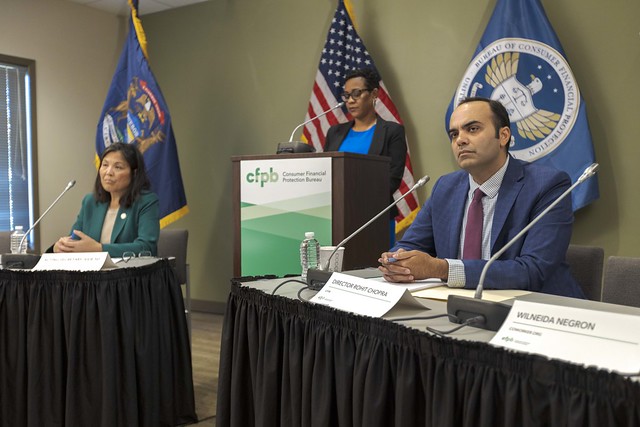
  • Why Neuter the Consumer Finance Protection Board (CFPB)?

    On February 9, 2025 it was reported by AP that the CFPB was ordered by the Trump administration to essentially cease all investigative activities. At this point, it is unclear what the organization may look like going forward, how it will operate or if it will exist at all. No big surprise here since Republicans have long despised the agency and tried to neuter it while democrats have heralded the agency and worked to expand it.

    Created in 2010 in response to the 2008 financial crisis, which started due to the crash of the home loan industry, the mission of the CFPB is to “regulate the offering and provision of consumer finance laws and to educate and empower consumers to make better informed financial decisions”.  It was created by Congress but operates independently under the Office of Management and Budget. It is important to note that the agency is not directly funded by Congress so it would be able to maintain independence from political pressure. 

    The CFPB has always been under pressure by banks and other finance institutions since it is a law enforcement agency aimed squarely at consumer finance companies. The arguments to eliminate it fall into three major buckets.

    1. It is a waste of government money and eliminating it will reduce the deficit.
    2. It delivers no value
    3. It is a duplicate regulatory agency

    The evidence is overwhelming contrary on all 3 points. The agency’s budget is funded by the Federal Reserve and eliminating it will have no direct impact to the federal budget unless the Federal Reserve decides to ask for less money in future years. Fat chance of that happening. Even if the Fed decided to do the right thing, the 2024 annual budget was $810M which represents a paltry .00012% of the annual federal budget. Not really a big opportunity. Regarding effectiveness, by any measure, the CFPB is highly effective and has delivered, on average, approximately $1.25B back to consumers annually since inception. The point about role duplication is partially true. While true that other law enforcement agencies regulate the financial industry, there are large gaps which is where the CFBP focuses. Additionally, simply shifting the work to another agency solves nothing since it will just shift the dollars from one agency to another while diluting the effectiveness of the receiving agency.

    In my opinion, the reason the Trump administration is going after the CFPB has zero to do with improving our Federal Government but rather to loosen the regulation of consumer finance companies such as banks, brokerages, payment processors, lenders and credit card companies. Essentially, the goal is to help the industry titans increase their profits and operate without guardrails. Deceptive practices have been, and still are, prevalent in these industries. Deceptive advertising, high interest rates, junk bonds, and exorbitant bank fees is just the tip of the iceberg. For example, currently the CFPB is litigating a $2B suit against Capital One for advertising high interest savings accounts that actually earn almost no interest at all. If successful, the winner is the American Consumer. If unsuccessful, the winners are the CEOs who will be more empowered to deceive, lie and cheat the consumer. A win for Trump and his close associates.

    Neutering the CFPB is clearly a conflict of interest since the Trump Organization is comprised of many companies with both direct and direct connections to consumer finance. TrumpMortgage, TrumpFinance and his most recently cryptocurrency company are just a few. Keep in mind that Trump University, although not directly a consumer finance company, made its money essentially deceiving, defrauding and exploiting  consumers. False claims, deceptive advertising and unclear costs were the hallmark of the scam. Let’s be clear, it was a scam. Trump lost fair and square in court and now he wants revenge against regulatory oversight.

    And that, ladies and gentlemen, is the real reason Trump is going after the CFPB. To improve the regulatory climate so he and is associates can continue making money by ripping off the consumer. The winner will be Trump and the titans of big business who promise him fealty by bankrolling his campaign with the profits made off the backs of the American people.